Coffee Table Styling Formula That Always Works
This post may contain affiliate links, which means we may earn a small commission at no extra cost to you. We may also display third-party ads and include links to partner brands or shops. Some images may be created or enhanced using AI or sourced from licensed platforms. All opinions are our own.
A coffee table can either anchor your living room or quietly create visual chaos.
Too many small objects make it feel cluttered. One lonely candle makes it feel unfinished. And when everything is the same height or scale, the table falls flat.
This guide gives you a simple, repeatable coffee table styling formula that works in almost any space. It’s structured, practical, and easy to adjust for your style.
You don’t need dozens of accessories. You need balance, proportion, and intention.
Here’s the formula.
The 3-Part Formula: Base, Height, Organic
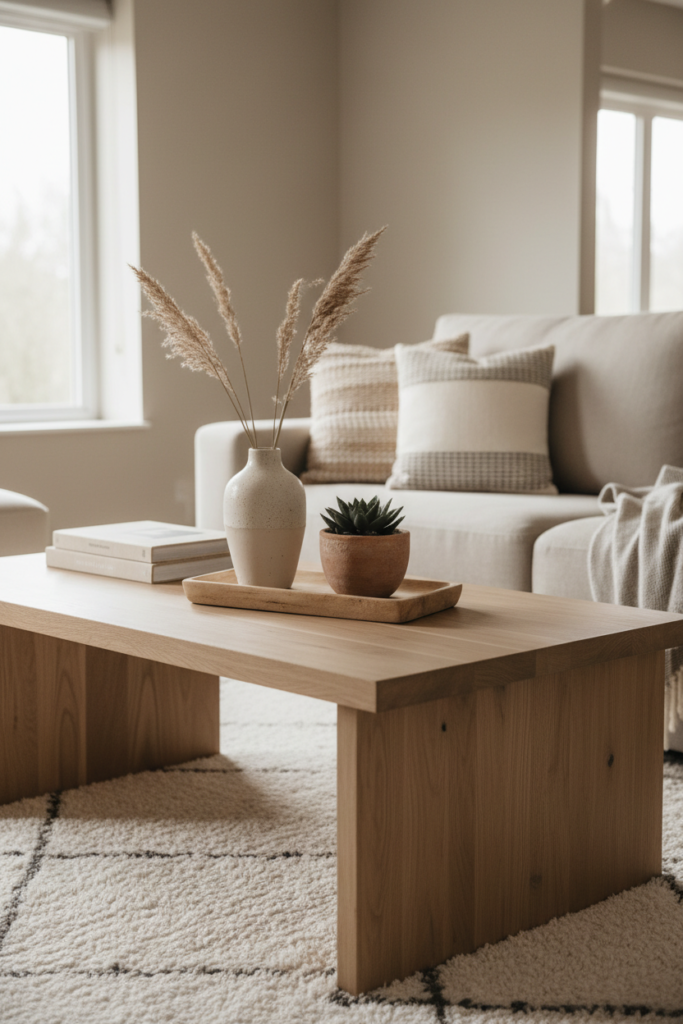
Every well-styled coffee table includes three essential elements:
- A base or anchor
- Something with height
- Something organic or soft
Think of it as a triangle. When these three elements are present, the table feels complete.
Let’s break it down.
Step 1: Start With an Anchor Piece
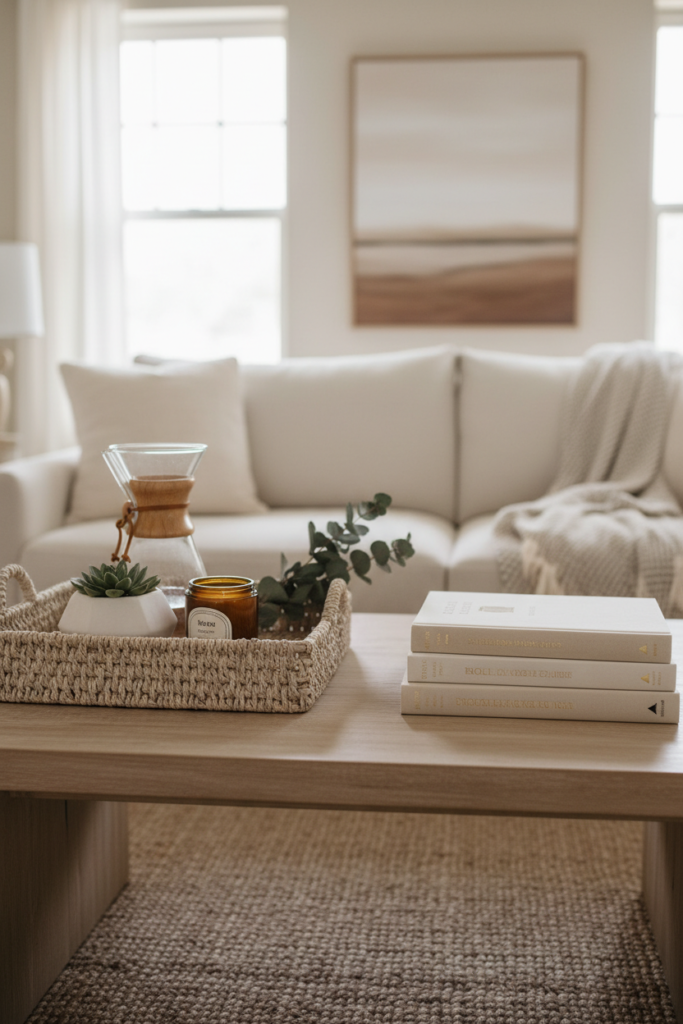
Every coffee table needs a visual foundation.
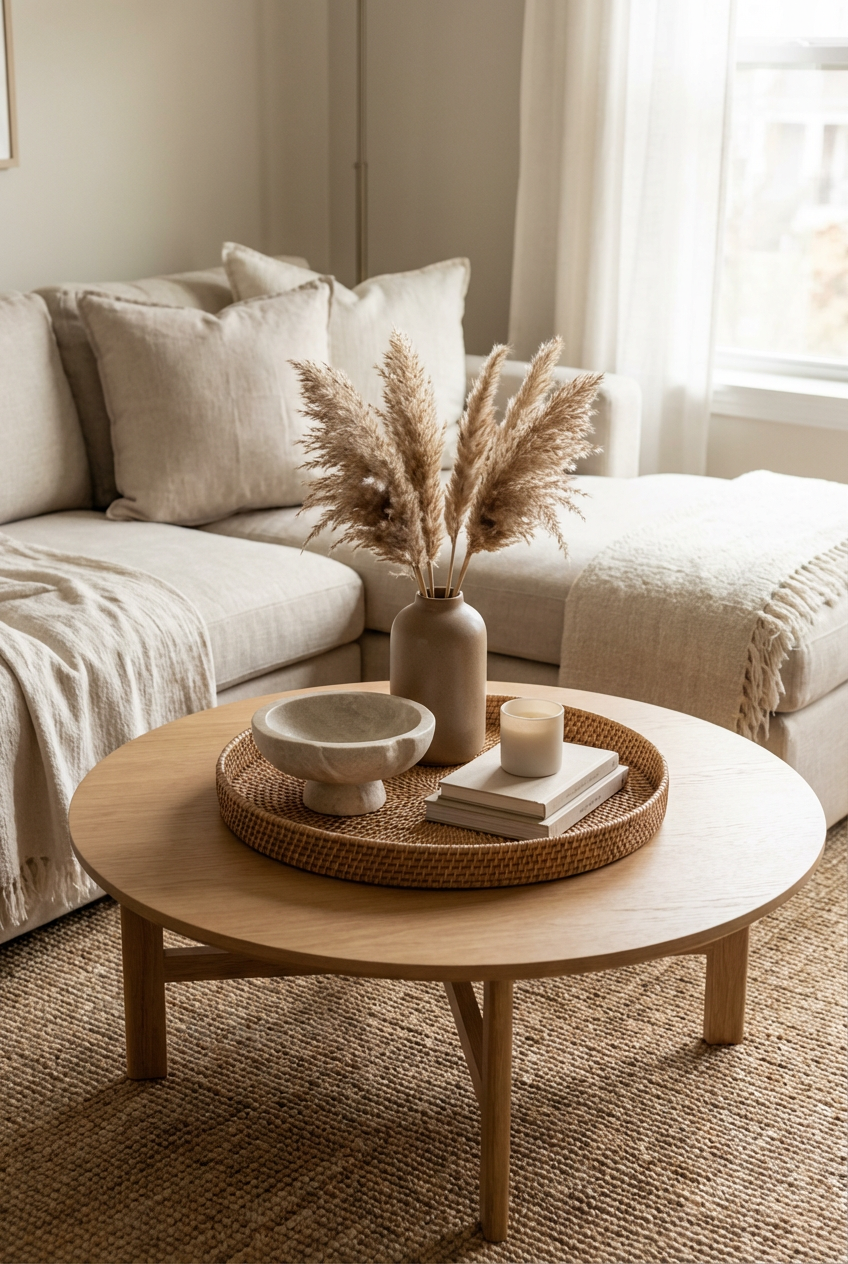
This is usually a tray, a large book stack, or a shallow decorative bowl. It grounds the arrangement and keeps smaller items from looking scattered.
For most standard coffee tables between 36 and 48 inches long, your anchor should take up about one-third to one-half of the table’s surface area. Not more.
If using a tray:
Choose one that’s roughly 12–18 inches wide for medium tables. On larger tables (50 inches or more), you can go up to 20–24 inches.
If using books:
Stack 2–4 large hardcover books. The stack should be 6–10 inches high total. Too tall and it blocks sightlines.
Why this works:
The anchor groups objects visually. Instead of seeing three separate items, the eye sees one cohesive arrangement.
Material tip:
Wood, woven rattan, marble, or matte metal trays add warmth and texture. Avoid glossy plastic finishes, which can look cold under overhead light.
Step 2: Add Height (But Keep It Controlled)
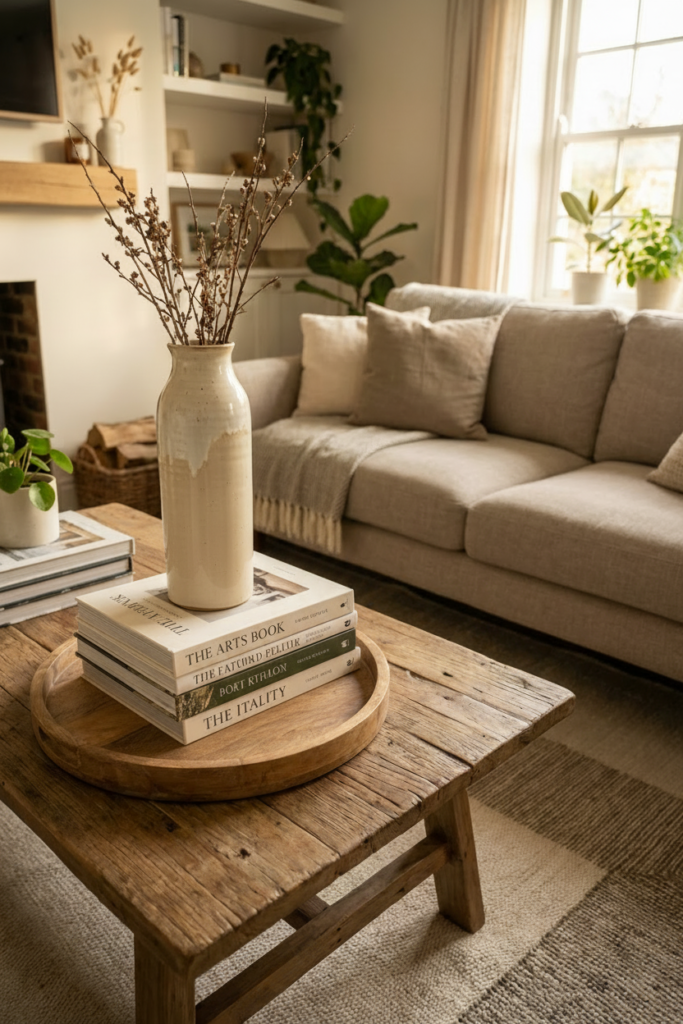
Next, add something vertical.
This could be:
A vase
A candle in a hurricane
A sculptural object
A small lamp (for larger tables)
The key measurement:
The height element should be approximately 1.5 to 2 times taller than your lowest object.
If your book stack is 8 inches high, your vase can be 12–16 inches tall.
Avoid exceeding 18 inches tall on most coffee tables. You don’t want to block conversation across the sofa.
Why this works:
Height creates dimension and prevents the table from looking flat. It also draws the eye upward and connects the table to the rest of the room.
For a balanced look, position the tall item slightly off-center on the anchor, not directly in the middle.
Step 3: Add Something Organic
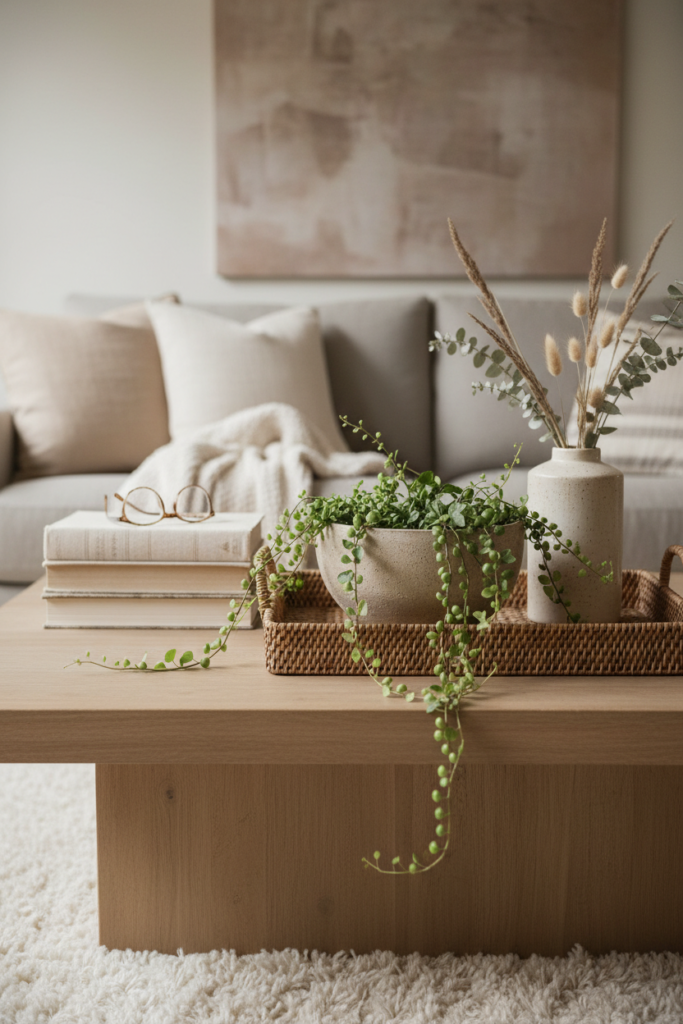
This is what softens the arrangement.
Organic elements include:
A small plant
Fresh or dried stems
A bowl of fruit
A textured bead strand
A ceramic piece with irregular edges
Keep it modest in size. Ideally 4–8 inches tall.
Why this works:
Organic shapes break up hard lines from books and trays. They add warmth and movement.
If your table and sofa are both structured and boxy, this step is especially important. A trailing plant or loose greenery introduces life and softness.
Color tip:
Pull a subtle color from your room. If you have sage pillows, add greenery. If you have warm terracotta accents, choose dried stems with warm undertones.
The Proportion Rule That Changes Everything
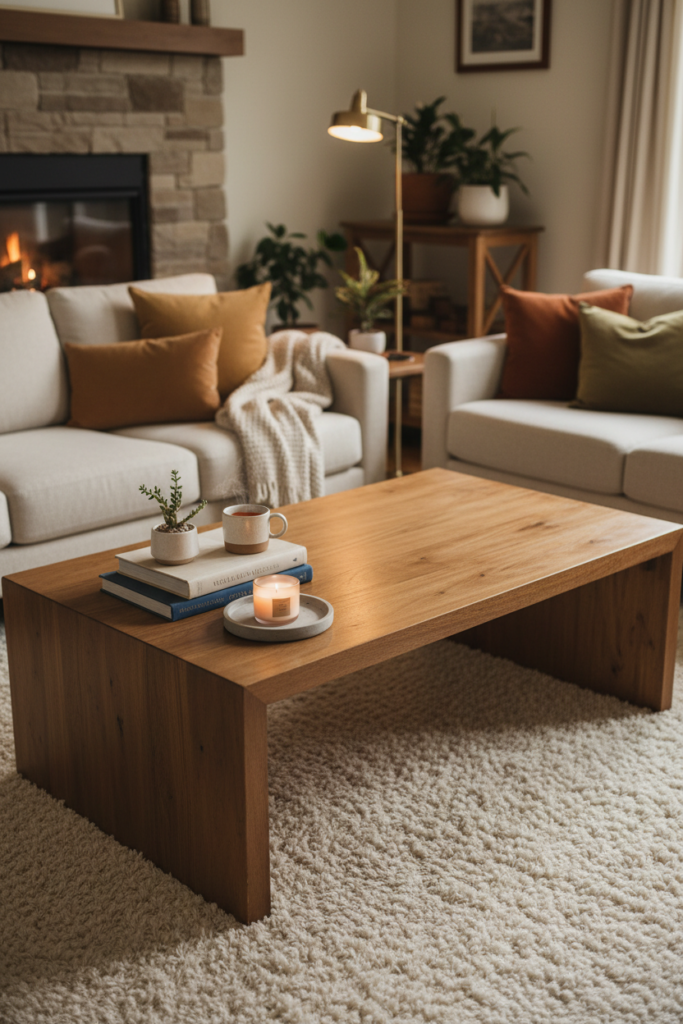
Here’s a rule most people overlook:
Leave at least 40 percent of the coffee table surface empty.
Negative space is what makes the styling feel intentional instead of crowded.
For example:
If your coffee table is 48 inches long and 24 inches deep, the styled section should occupy roughly one half of the surface, not the entire thing.
The remaining space gives room for:
Drinks
Books
Remote controls
Breathing room
This makes the table functional, not just decorative.
Round Table Formula
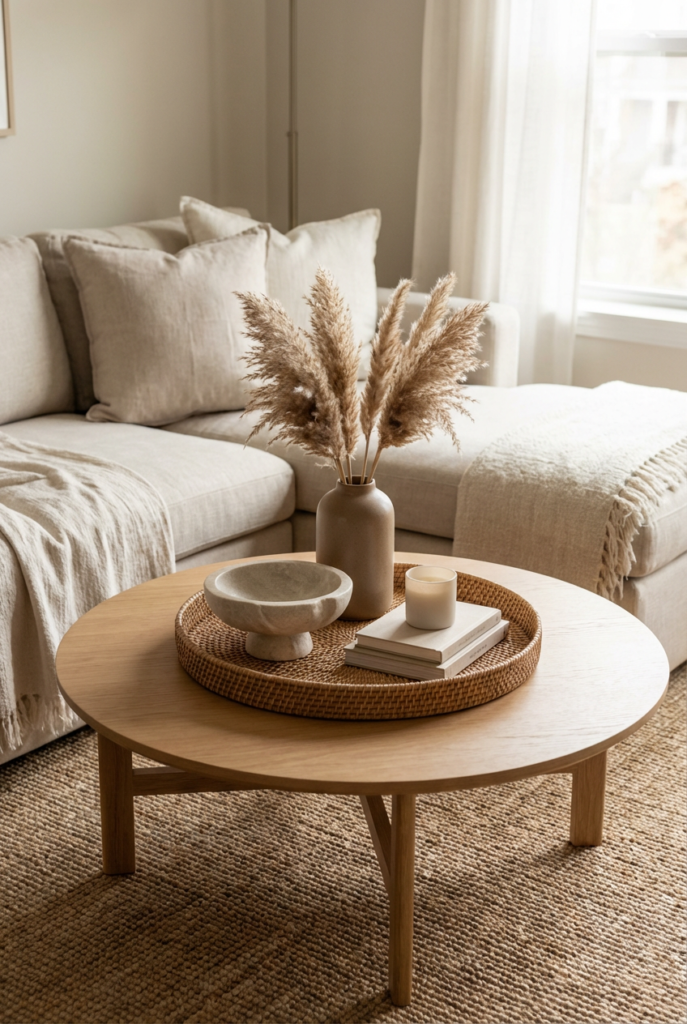
Round coffee tables need slightly different styling.
Instead of placing everything in one cluster, create a loose triangle layout.
Use:
One medium anchor (like a round tray 14–18 inches wide)
One taller object
One low object
Avoid placing items around the edge. Keep the arrangement centered within the middle third of the table.
If the table is under 30 inches in diameter, keep the styling minimal. A single tray with one height element may be enough.
Large Rectangular Table Formula
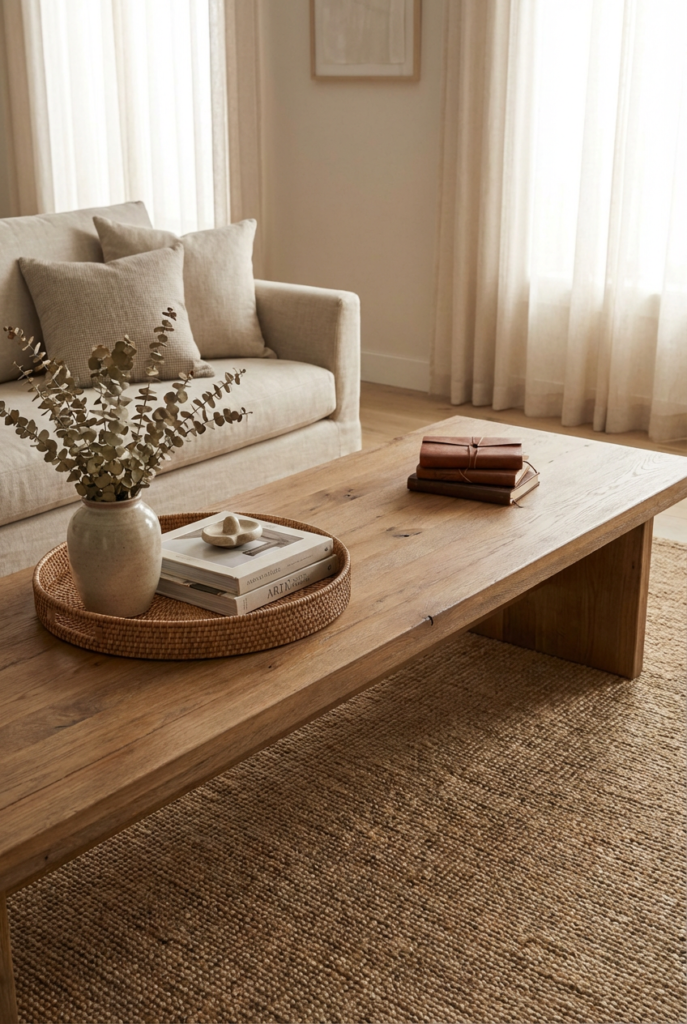
For tables longer than 50 inches:
Divide the surface visually into two sections.
Style one side using the 3-part formula.
On the other side, keep it minimal with either:
A small stack of books
A single decorative box
Or nothing at all
Do not mirror the arrangement exactly on both sides. Symmetry often feels stiff on coffee tables.
Instead, balance visual weight.
The Height Layering Rule

Avoid objects that are all the same height.
Your arrangement should include:
One tall element (10–16 inches)
One medium element (5–8 inches)
One low element (1–4 inches)
That height variation creates dimension and shadow.
When evening light hits the table, the subtle differences in height create soft contrast and depth.
Keep Function in Mind
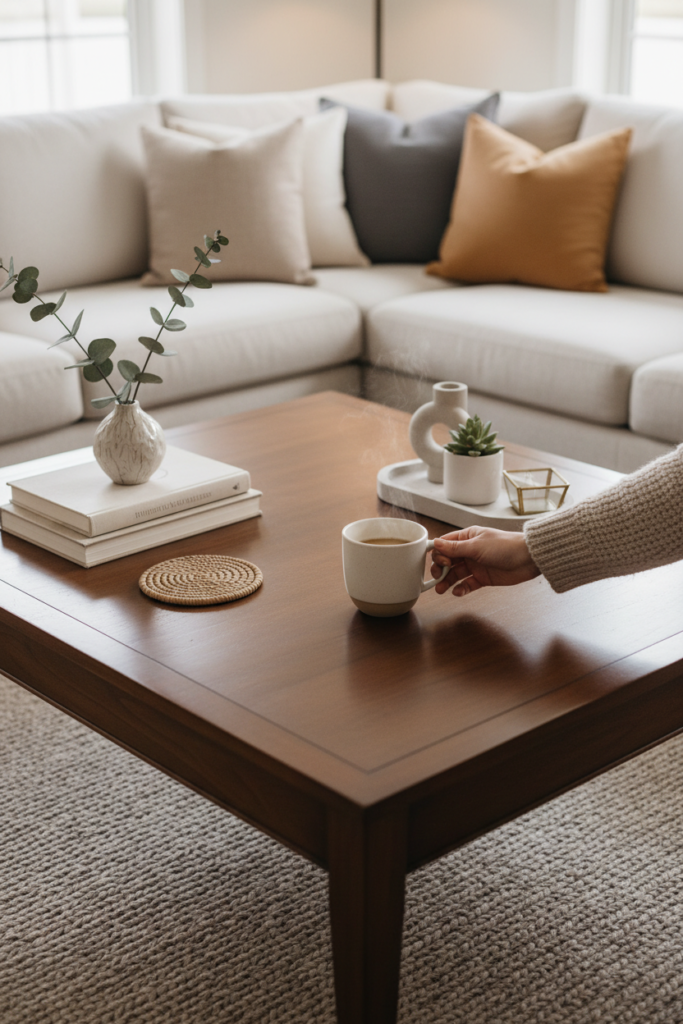
A coffee table is meant to be used.
Before finalizing your arrangement, test it.
Can you comfortably set down a cup without moving three objects?
Can someone reach across without knocking something over?
If not, simplify.
Styling that works always respects function first.
Common Mistakes
Using too many small objects
Tiny pieces scattered across the surface create visual noise. Combine items on a tray or reduce the number.
Centering everything perfectly
Coffee tables look better slightly off-center. Perfect symmetry can feel stiff.
Choosing decor that’s too tall
Anything over 18–20 inches can block sightlines and conversation.
Ignoring scale
A small tray on a large table looks lost. Increase size proportionally.
Forgetting texture
If everything is smooth and shiny, the arrangement feels cold. Mix materials like wood, linen, glass, or ceramic.
Overfilling the surface
Crowding the entire table eliminates breathing room. Negative space is essential.
Pro Tip for a Cozier Look
Lower the visual weight slightly.
If your room feels formal, swap one tall structured vase for something softer. Try a ceramic vase with a matte finish or loosely arranged greenery that bends naturally instead of standing stiff.
You can also add one tactile detail.
A small woven coaster stack. A linen-wrapped book. A wooden bead strand draped casually across a tray.
When light hits textured materials, it creates subtle shadows that make the table feel layered and lived in.
That’s the difference between styled and cozy.
Final Thoughts
The coffee table styling formula is simple:
Anchor.
Height.
Organic.
Negative space.
Once you understand proportion and scale, you can repeat this formula in any living room.
Keep it functional. Keep it balanced. Keep it edited.
A well-styled coffee table doesn’t demand attention. It quietly supports the room, making everything feel intentional and complete.
And once you get the proportions right, it truly always works.

Hi, I’m Livia. A mom who believes that a house becomes a home through the little things.
Over time, I started to understand what truly makes a space feel cozy, comfortable, and safe. Little by little, I transformed my own home into a place where my family and I genuinely love to be, a space that feels calm, warm, and ours.
Here, I share simple ideas and thoughtful inspiration to help you turn your home into your favorite place in the world too.